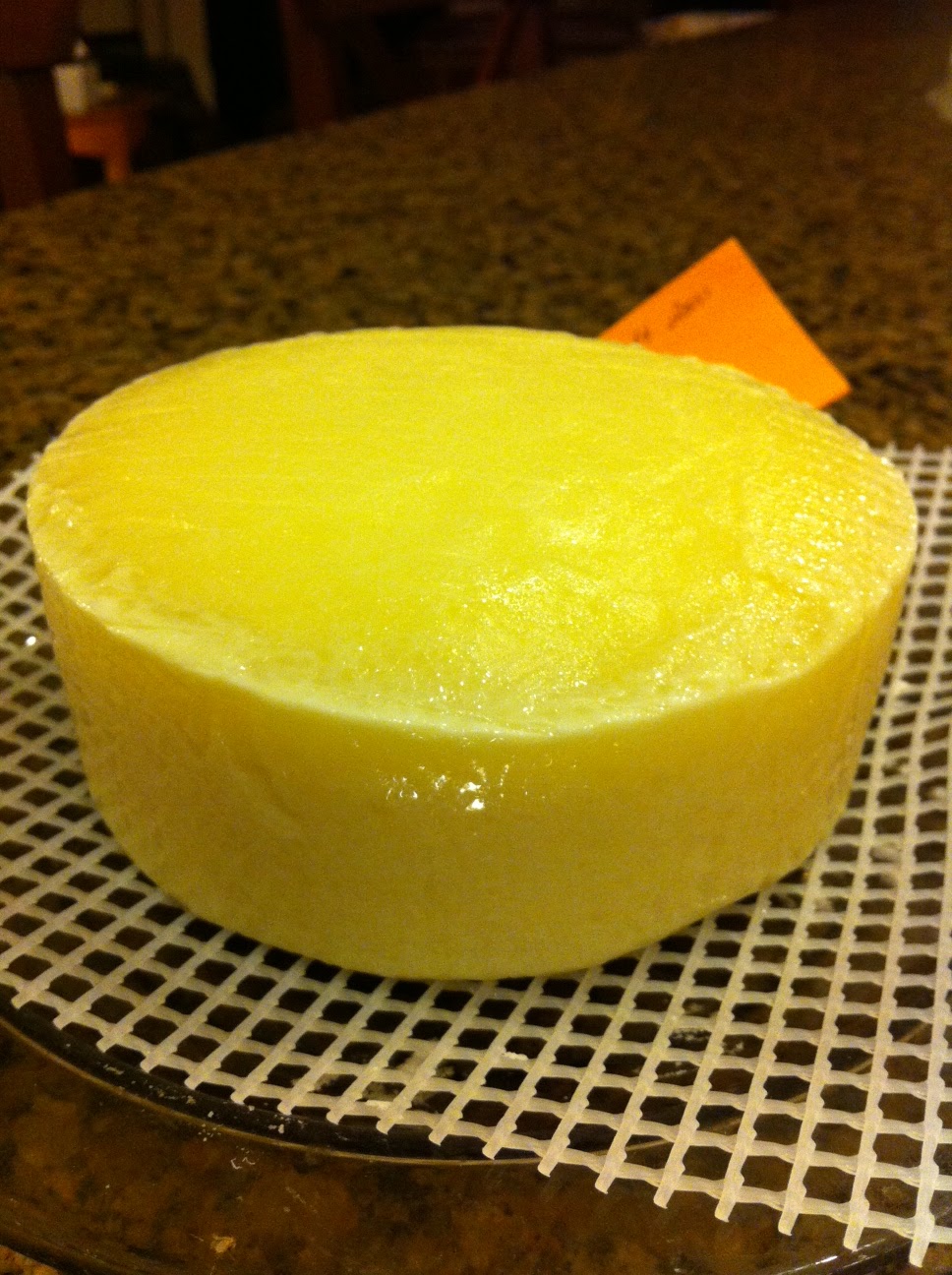
Adventures in Cheesmaking

This all started out as a curiosity. Like most stuff we eat there is a rich history behind it. Centuries of experimentation. Cheese is just another example.

From the horse back tribes of the Asian Steppes to the Silk Road camel caravans to Romans Legions to European Monks to today, milk was a great source of nutrition but spoiled quickly and was heavy to transport.

The answer was cheese.

Saturday, October 8, 2011

Sage Darby

We have a great crop of sage in the herb garden - in the next couple of weeks I will use it to make a great pepper and sage Darby

Base recipe
Derby Cheese
This cheese, pronounced "Darby" originated in the country of Derbyshire, England. It is similar to cheddar but has higher moisture content and ages more quickly.

I made this cheese last winter and we enjoyed it but it wasn't spectacular. In fact, most of my cheese was good, but not spectacular. This year, I started using my clabber/buttermilk in place of mesophilic starter culture. This cheese went from mediocre to great. In fact, since I am terrible at letting cheese age, I tested it at two weeks and it was really good. I can't wait to see what it tastes like with a little age on it. Well, that's assuming I can actually get some age on wheel before eating it all! 

GENERAL

  • Preparation time: 4 Hours
  • Pressing Time: 26 Hours
  • Aging Time: 1-2 Months
  • Makes 4 pounds

INGREDIENTS
  • 4 gallons of whole milk
  • 2 cubes or 1/4 c mesophilic starter culture (I use buttermilk/clabber)
  • 1/2 tablet rennet, dissolved in 1/2 cup cool water
  • 1/4 cup salt

DIRECTIONS
  • Heat milk to 84 degrees F. Add starter culture, mixing well. Cover and let ripen 30 minutes.
  • Add dissolved rennet, stirring well. cover and let sit 45 minutes.
  • Cut the curd into 1/2" cubes.
  • Heat slowly to 94 degrees, stirring the curds by hand. This should take 30 minutes.
  • Let the curds settle for 30 minutes.
  • Drain the whey and allow curds to sit in colander for 30 minutes.
  • Cut into four slabs. Stack slabs on top of each other, reversing their order every 20 minutes for one hour.
  • Tear slabs into pea sized pieces. Sprinkle 1/4 cup salt over curds. Mix well.
  • Pack curds into a cheesecloth lined mold.
  • Apply 10 pounds pressure for one hour. Flip and repack. Apply 10 pounds pressure for one hour. Flip and repack. Apply 50 pounds pressure for 24 hours.
  • Air dry cheese on a mat for several days until dry to the touch. Turn twice a day.
  • Wax cheese and age it for 1-2 months at 50-55 degrees turning it twice a week.


Sunday, September 11, 2011

Carbonzola

At 6 weeks it was excellent!

When we lived in Belgium, this cheese was responsible for at least 10lb of weight increase and who knows how much cholesterol.

Carbonzola - as the name suggests is a hybrid cheese - a camembert inoculated with  Penicillium roqueforti mold , the same mold used to make a range of blue cheeses such as Roquefort and the Italian Gorgonzola. What you get is the best of both worlds. The taste and aroma of an early and mild blue with the soft creamy texture of a camembert.

Normally Camembert has a Fat to Protein ration of 0.9, achieved by the addition of about 2 tables spoons of heavy cream per gallon of full cream milk. See the Camembert blog for details.

In this case I am making it with a ratio of 1:1 - using just full cream milk. If you want the uber rich version - add the cream. Also I have chosen to use as my Penicillium roqueforti source, a nice piece of Gabriel Coulet Roquefort - a dreamy French sheeps milk semi soft blue - perhaps the very best of its type - see more details in the Tasting Notes section of the blog.

As you will see the Penicillium roqueforti is added while the curds are being added to the hoops so for this batch I am going to make one Camembert and one Carbonzola from the same batch.

In the past I have made two small 5 oz Camembert's from one 1/2 gallon - so we will see how much we can fit into the molds by dewatering a bit first and then trying to build two 8-10 oz wheels. We will also see if I can make them without cross contamination.

For this batch

Recipe

You will need:

1 gallon of full cream milk - I chose Whole Foods 365 Whole Milk

Calcium Chloride solution
Mesophilic Starter - pinch
Penicillum Candidum - pinch
Geotrichum Candidum - pinch
For this recipe I used a combined pack
Calf Rennet powder - 1/8 tsp
Penicillium roqueforti from Gabriel Coulet Roquefort sheeps milk cheese

Draining mats
Camembert forms 4 inch

Method

Heat milk to 90 F
Add 20 drops calcium chloride solution in 1/4 cup non coordinated water
Add
Mesophilic Starter - pinch
Penicillum Candidum - pinch
Geotrichum Candidum - pinch
Mix and hold at 90 F for one hour
Add Calf Rennet powder - 1/8 tsp in 1/4 cup non coordinated water
Mix for 2 minutes and then leave undisturbed for one hour

Once you have a clean break confirmed cut the curds into large 1 inch pieces and GENTLY mix the curds for 5 minutes and allow for some whey separation. Drain about 1/4 gallon of whey. Then using a spoon transfer curds to the hoops placed on draining mats. Fill hoops to half full.

For the Carbonzola

- blend a teaspoon of Roquefort cheese vein with water to a paste.
- drizzle this paste over the 1/2 full hoop

Then - continue to fill the hoop to the top and allow to drain for 30 minutes.

Flip hoops and allow to drain for one hour

Flip hoops and allow to drain for one hour

Flip hoops and allow to drain for 3 hours

Flip hoops and allow to drain overnight (12 hours)

Remove from hoops and salt all sides with one tablespoon of cheese salt

Place in cave at 95% humidity at 50-55F for 8-12 days to allow white Penicillum mold to grow on the surface. The mold should start to appear at days 6-8. Turn the cheese daily.

For Carbonzola - at day 5 - remove cheese from cave and pierce wheel through the side (horizontal) with a clean skewer every 1/4 inch. The idea is to allow oxygen to reach the roqueforti molds that require oxygen to grow. This will produce the blue veins in the cheese. Place back in the cave.

Remove one the cheese has a good white coating. Wrap in breathable cheese paper and transfer to a colder cave at 45-50 F to age for 3-5 weeks.


Prep the tools
Prep the tools
Cut the curds

Stir for 3-4 mins
Remove 1/4 whey
Prep the hoops


Do not eat all the blue!
Make a slurry
Add blue slurry


Fill hoops


After overnight draining - remove from hoops and salt all sides and air dry for the day. Notice the front wheel is the Carbonzola. You can see some flecks of blue.


After 12 days at 55F the Camembert foreground and Carbonzola had an excellent healthy white growth coat and were ready for wrapping and storage for three weeks at 50F
Using a wooden skewer holes were poked through the round from sides and top to allow air access for blue growth
Ready for wrapping and storage at 50F for three weeks


At 6 weeks - perfect


Saturday, September 10, 2011

Caerphilly leaves the cave

This turned out to be a great cheese.
Caerphilly

Just on 4 weeks ageing . A bit crumbly, but firm and easy to eat, just as it should be for this cheese, perhaps a bit like a Colby. Great flavor. A hard rind but with no strong flavor and perfect to eat. I liked the combination of creamy taste with solid but not overwhelming.

A great cheese to have with an ale or will even stand up to a larger.

Sunday, September 4, 2011

Camembert leaves the cave!


From the earlier Camembert production post September 4th - one month exactly ageing.

After production  they were placed in the cave. After 10 days in the 50F cave they had a good cover of mold. They were wrapped in breathable two layer cheese paper and placed in the cold cave 45F for another and a bit weeks.

One felt ready so we opened it up - great news - wonderful creamy center - mild but good taste. I think I got it at just the right time!

These turned out on the small side - about 5oz each - so 10oz from a 1/2 gallon. In future I would like to shoot for two 8 ounce - I'm thinking perhaps a gallon and make 2 larger ones and see how that goes.


Gruyére

So this is going to be a 12 month labor of love - the result I hope will be close to a Le Gruyére Premier Cru - the 12 month cave aged classic.

A little about this excellent cheese and its brother and sisters in the "Swiss Cheese" family.

Three things set these cheeses apart

- The curds are broken into small pieces and slowly heated and then "scalded" at 120F. This causes significant dewatering of the curd.
- While the rinds are salted and washed with brine during ageing salt is not added to the curd
- The contain a Propionic bacteria and thermophilic lactic acid bacteria. The lactic bacteria convert the lactose sugars into lactic acid and then after a few weeks of 55F  ageing the cheese is aged at room temperature, 70F. The Propionic bacteria consumed the lactic acid from the first stage and produce acetate, propionic acid and carbon dioxide. The first two give the cheese its characteristic nutty flavor and the latter the holes. If you would like to read more about the chemistry of propionic acid and acetal, two widely found chemicals in natural and fermented foods have a look at these wikipedia links http://en.wikipedia.org/wiki/Acetate http://en.wikipedia.org/wiki/Propanoic_acid

Taken together we get a wonderfully flavored family of cheese, complex and nutty. A strong aroma. An excellent melting cheese used in fondues and the very best grilled cheese sandwiches you ever had.

The most widely know are Emmentaler and Gruyere. Each come from their own unique small Swiss valley. Emmentaler is made from  partially skimmed cows milk with a protein fat ration of 0.8 while Gruyere uses higher milk fat, around a P:F of 1, closer to the full cream milk we know. In the US, Baby Swiss is made with full cream milk but has a shorter ageing time. Just FYI - the Swiss Raclette so well know as a melting cheese where the cheese is melted and scraped onto break and charcuterie, is made with partially skimmed milk like Emmentaler but at a lower scald temperature and without propionic bacteria - so no holes and a milder flavor and aroma.

Gruyere can be found as a mild 4 months, medium 8 months and Premier Cru at 12 months + cave ageing. The extended ageing and higher fat content compared to Emmental, results in very small and at time no "eye" or gas bubbles in Gruyere. Historically the cheese would be made from milk collected  from cows in their high summer pasture eating grass, wild herbs and flowers giving the cheese debts of flavor and aroma.

I have chosen to make a Gruyere style. I adjusted the full cream milk with some skim - I was trying for a little more like Emmentaler, a bit firmer than Gruyere perhaps, we will see.

Method

1 gallon organic homogenized full cream milk
1.5 cups skimmed homogenized milk


Curd Production
Adjusted to give a Protein : Fat ratio of 0.95
Heat to 88 F
Add Thermophilic Starter
Add 1/16 tsp Propionic Shermanii
Add 20 drops Calcium Chloride in non 1/4 cup chlorinated water
Stir and mature for 10 minutes
Add 20 drops double strength vegetable rennet in 1/4 cup non chlorinated water
NOTE: The pH was 6.5
Mix and allow to set covered for about 30 minutes until a "clean break" is achieved
Cut curd to 1/4 inch cubes
Stir and hold at 90 for 40 minutes of "fore-working" to start to dehydrate the curds
Using a wish reduce curd to the size of rice grains
Drain 1/3 whey and replace with hot water at 140F
Raise temperature with mixing 1 F per minute
Hold at 120F for 40 minutes to "scald the curds" with frequent stirring and complete dehydration
Test for completeness and a "proper break" buy taking a palm full of curds and squeeze into a ball. The curds should crumble when rubbed.

Cheese Production
Drain the whey to the curd level
Drain the curds in a strainer lined with cheese cloth
Transfer to the cheese press and press for 10 minutes at 5 lbs
Remove from press, unwrap, flip, rewrap and press for 30 minutes at 10 lbs
Remove from press, unwrap, flip, rewrap in cheese cloth soaked in saturated brine for 2 hours at 15 lbs
Remove from press, unwrap, flip, rewrap in cheese cloth soaked in saturated brine for 12 hours at 15 lbs

Brineing
Remove and unwrap and float in a tub of saturated brine for 24 hours turning 4 times

Ageing
Remove and pat dry. Age in cheese cave at 50-55 F 85-95% humidity for 14 days - turn every few days and wipe rind with damp cheese cloth soaked in brine.

Remove and age at 70-75 F for 2-3 weeks. Daily turn the cheese and wipe rind with damp cheese cloth soaked in brine. The cheese should swell as the propionic bacteria develop rapidly at room temperature and produce carbon dioxide.

Place back in cheese cave and age at 45F 80-85% humidity for 6-12 month. Turn weekly. Wipe any mold from surface with brine dampened cloth. The rind will form a dull red color.


Pics
Thermophilic starter
Propionic shermanii
After 10 minutes with starter added pH is 6.5

Cut the curds


After  40 minutes settle curds and remove 1/3 whey, replace with 140F water

Wisk curds to the size of rice grains

Remove whey

Drain curds in cheese cloth

Place in press

Complete press cycle

Place in brine

After 10 days at 55F and daily brine wash place at 70F for 10 days to allow  Propionic bacteria to do their thing.


After 7 days at 72F you can see the swelling from  the CO2 production.  I washed it down with salt and placed it in the cave at 50F


After 18 Months - well mixed results. It is too dry. My guess the humidity was  not high enough. The
rind was very had and the body was almost chewy. It tasted ok but was not what you would want.


Thursday, August 25, 2011

Carbonzola - suggested recipe

For later reference - this great soft blue was a staple for us when we lived in Belgium - it on the must make list

Making Cambozola Cheese


 Cultures needed for a one or two gallon milk batch.
-Mesophilic Starter Culture (MM100-101 series or MA4000-4001 series or MA11-14-16 series) 1/3 tsp.
-Penicillum Candidum 1/16th tsp.
-Penicillium Roqueforti 1/32nd tsp.
-Rennet(dissolved in a little amount of cool water). Use amount per stated on rennet package. Use any type of rennet.
-Calcium Chloride/optional/use ¼ tsp.(1.25ml) in ¼ cup of cool water.
-Non-iodized course salt

Milk:
Raw milk or 1 part heavy cream to 7 parts skim milk or non-homogenized whole milk.

Procedure:
Heat milk/cream to 85f (29.5c). Maintain this temperature throughout the process. Sprinkle the Penicillum Candidum and Mesophilic Starter Culture onto the warmed milk, allowing the dry cultures to thoroughly hydrolize. Then add the rennet and stir for a few minutes. Do not add the Penicillium Roqueforti  at this point.  It will be added later. Then gently stir the milk 2-4 minutes using top to bottom strokes. Allow the curd to set and test for clean break after about 60 minutes. After getting a clean, gently cut curds into ½ inch (1.5cm) cubes. Stir curds in the whey for 2-4 minutes. Drain off nearly 80% of the whey from the curds using either a colander or draining bag for 25-30 minutes. Now ladle the drained curds in your camembert moulds until they are half full using about 50% of the curds. Sprinkle a very small dusting of P. roqueforti mold powder (about 1/16 tsp.) on the top of the curds.  Ladle the rest of the curds into the half full Camembert moulds. Let the filled
 moulds drain for 16-24 hours at room temperature until you see no additional draining. Turn the moulds over during this draining period multiple times so they drain uniformly. Once your cheese are drained and firm enough, take them out of their moulds and place them onto a draining mat/platform for salting. Lightly sprinkle about 1 tsp. of course non-iodized salt on all sides of each cheese. After salting, the cheeses can be set aside to age. The temperature should be 50-54f (10-12c) in your aging room. Cover your aging container when the cheeses no longer look excessively moist, making sure there is no moisture touching your cheeses. Flip your cheeses daily using clean hands. The white mold should begin to appear within 3-6 days, maybe a bit longer if the temperature is colder. After you see a good covering of white mold bloom on the cheeses, use a clean knitting needle or clean thin Phillips Head screwdriver, poke about 10 holes through the top of each cheese. These holes
 will air and help in the development of blue veining. Continue to age at 40-50f. You may have to re-poke holes if additional white mold bloom covers the holes. About 10-14 days after the first poking, wrap you cheeses in White Mold Paper and continue to age until you like the flavor. When the center of the cheese is a bit soft to the touch it has completed aging.  You can cut one cheese in half to see how ripe it is. A longer aging period will result in a stronger blue flavor.

Note:  Sometimes due to the fact that the holes may cover up even after you poke them, there is another way to get the blue mold to grow inside the cheese.  After a couple of days of aging when the cheeses are quite firm, using clean fishing line or some kind of clean string, cut the cheese in half horizontally.  Using a fork, scratch up the inside center of both halves.  Then, sprinkle a very tiny amount of the blue mold powder onto one of the halves.  Place the two halves back together and set aside to age.  Since the blue mold needs to grow, the small amount of air now inside the cheese will allow it to blue inside.

Sunday, August 14, 2011

Caerphilly

This is a working class cheese from Wales. When I grew up a "Cornish Pasty" was a great alternative to a "meat pie" for lunch. But my lunch at school was a very different lunch from the people who invented "dirty hands eating".

Cornish Pasty


The Pasty was a food of the Coal miners. A meat and vegetable filled pasty parcel with a thick hard crust on one end was an ideal food to hold in one coal black hand and eat a hearty meal underground. The cheese was often wrapped in cabbage leaves. The same was true for Caerphilly Cheese (pronunciation). Named after the region in Wales this salty cheese with a tough natural rind did not spoil and was a good part of a meal, replacing the salts lost through hard work underground, and like the Pasty, the rind could be discarded once soiled by coal black hands.

So as you sample this full cream, salty cheese, think of the miners peering at their lunch through the light of their helmet candles, with black hands - eager for their cheese and pasty.
Cheese 32 bg 051906.jpg
Caerphilly
The Recipe - makes approx 1 lb wheel
Thanks to fellow Aussie 
for suggestions 

1 gallon full cream milk
1/8 tsp calcium chloride solution  in 1/4 cup non chlorinated water
1/8 tsp Mesophilic Starter 

  • (LL) Lactococcus lactis subsp. lactis
  • (LLC) Lactococcus lactis subsp. cremoris

1/8 tsp liquid vegetable rennet ( any rennet will do) in 1/4 cup non chlorinated water
1 table spoon salt

Directions
Heat the milk to 90 F
Add the starter and let rest and develop for 20 minutes
Add Rennet with stirring and 2 minutes and let rest at for 40 minutes or longer until you get a clean curds break
Cut the curds into 1/2 inch pieces 
Heat slowly to 92 F with constant stirring and hold for 40 minutes
Drain the curds into a cheese cloth lined colander
Once the curds have drained, cut and "Cheddar" the curds three times in 15 minutes (To "Cheddar" the curds you cut them into 1 inch slabs and stack them up in the along the side of the colander. This helps the syneresis (release of water from the proteins)
Crumble the curds into bits about 1/4 - 1/2 inch
Min in 1 table spoon of seal salt (yes this is a very salty cheese!)

Place the cheese cloth into a mold and press - I use a 5 inch open bottomed mold
Start the press cycle
5 lb for 10 minutes - remove salt the ends, flip and  rewrap 
10 lbs for 30 minutes - remove salt the ends, flip and rewrap
20 lbs over night for 12-16 hours

Ageing
Place on a board and draining mat for air flow at room temp (65-75 F) for 2 days till dry to the touch turning a few times a day to allow even drying and fat distribution. The cheese quickly formed the start of a dry rind.

Place in a "cheese cave" - in my case the crisper draw of the fridge at 50 F and >85% humidity for min 3 weeks.
Turn every few days while ageing and if molds develop wipe with a saturated salt solution.

Curds after 40 minutes at 92 F

Drain Curds


Cheddar the Curds

Crumble and salt


Press


Remove salt and flip

Overnight press in "Patented" Cheese  press!

Ready for ageing 

UPDATE September 4th

After three weeks in the 55F cave at 85% humidity the cheese has a sold yellow hard rind and I am thinking it is a week away from being cut. Often this cheese is eaten at the three week mark but I think I will develop the flavor a bit more.

Update September 10th

A great cheese - this one will be made again. Perfect for a beer with friends. Good flavor, a salty and creamy taste.
Caerphilly